


How to Migrate an OJS Agriculture Journal to a Modern Journal Management Platform
How to Migrate an OJS Agriculture Journal to a Modern Journal Management Platform
Over the past two decades, many agricultural journals have adopted Open Journal Systems (OJS) as their preferred publishing platform. OJS has played a significant role in democratizing scholarly publishing by providing an open-source solution for journal management and online publishing.
However, the scholarly publishing landscape has evolved considerably. Modern agricultural research is increasingly interdisciplinary, data-driven, and globally collaborative. Journals today are expected to provide seamless author experiences, efficient editorial workflows, professional website design, advanced metadata management, and scalable publishing infrastructure.
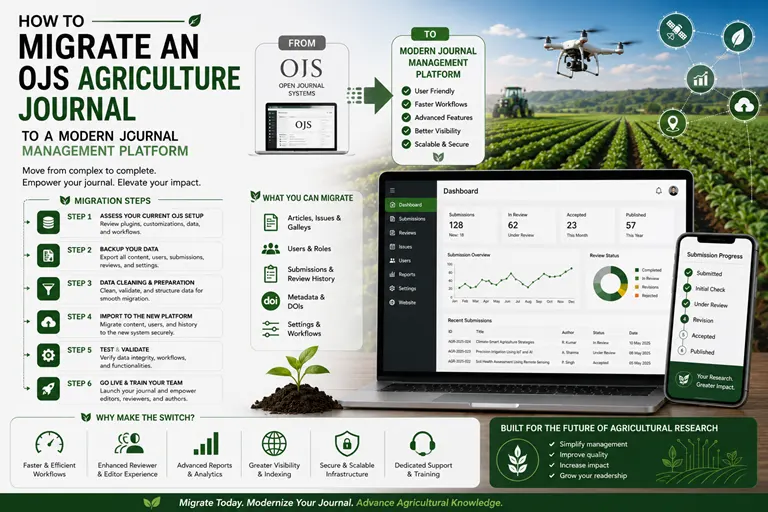
As a result, many agricultural journals are evaluating whether their existing OJS installations continue to meet their growing needs.
Migrating from OJS to a modern journal management platform is not simply a technological upgrade. It is often a strategic decision that improves operational efficiency, strengthens journal reputation, and prepares the publication for long-term growth.
The Journal of Agrosystems and Analytics (JAA) recognizes the importance of robust publishing infrastructure and supports the adoption of technologies that improve scholarly communication and editorial excellence.
Why Agricultural Journals Are Considering OJS Migration
Agricultural science has changed dramatically in recent years.
Modern journals now publish research in areas such as:
- Precision agriculture
- Artificial intelligence in farming
- Remote sensing and GIS
- Climate-smart agriculture
- Agricultural data analytics
- Sustainable resource management
- Agricultural biotechnology
- Digital farming systems
These research areas generate:
- Larger submission volumes
- International collaborations
- Complex peer review requirements
- Higher expectations regarding publication speed
- Greater demands for data management
Many journals find that older publishing infrastructures struggle to support these evolving requirements.
Common Challenges Faced by OJS-Based Agricultural Journals
Technical Maintenance Burden
Although OJS itself is free, maintaining an installation often requires:
- Server administration
- Software updates
- Security management
- Backup procedures
- Plugin maintenance
Editorial teams frequently lack dedicated technical staff to manage these responsibilities.
Plugin Compatibility Issues
Many journals depend on multiple plugins for:
- DOI registration
- ORCID integration
- Citation management
- Metadata exports
- Search engine optimization
Software upgrades can occasionally create compatibility challenges.
Customization Limitations
As journals grow, they often require:
- Better user interfaces
- Advanced workflow features
- Improved reporting systems
- Enhanced mobile responsiveness
- More sophisticated publishing tools
Custom development can become costly and difficult to maintain.
Editorial Workflow Complexity
Editors often seek:
- Faster manuscript processing
- Automated communications
- Better reviewer management
- Real-time dashboards
- Performance analytics
Traditional workflows may not always provide the flexibility required by expanding journals.
Increasing Author Expectations
Authors increasingly expect:
- Professional journal websites
- Intuitive submission systems
- Transparent workflows
- Mobile accessibility
- Faster editorial decisions
Providing a positive user experience has become essential for attracting quality submissions.
Signs That Your Agricultural Journal May Need Migration
Several indicators suggest that it may be time to consider upgrading your publishing platform.
Frequent Technical Problems
Repeated software issues consume editorial time and resources.
Slow Editorial Processes
Inefficient workflows increase publication delays.
Growing Submission Volumes
Increasing manuscript numbers require scalable systems.
Poor User Experience
Authors and reviewers may struggle with outdated interfaces.
Difficulty Maintaining the Website
Website updates and customization become increasingly challenging.
Lack of Technical Support
Editorial teams may need more comprehensive publishing assistance.
If several of these challenges apply to your journal, migration planning may be appropriate.
What Does a Modern Journal Management Platform Offer?
Modern publishing platforms go beyond basic manuscript handling.
They typically provide:
- Professional journal websites
- Manuscript submission systems
- Editorial workflow management
- Reviewer management
- Publication workflows
- Metadata management
- Mobile optimization
- Reporting and analytics
- Technical support
- Publishing consultation
These integrated capabilities help journals focus on scientific quality rather than technical administration.
Benefits of Migrating to a Modern Platform
Improved Editorial Efficiency
Automated workflows reduce administrative burdens.
Better Author Experience
User-friendly systems improve submission experiences and author satisfaction.
Enhanced Reviewer Management
Editors can track reviewer activity more effectively.
Professional Website Design
Modern websites improve credibility and discoverability.
Improved Metadata Management
Structured metadata supports indexing and long-term visibility.
Scalability
Cloud-based systems can accommodate growing submission volumes.
Dedicated Technical Support
Professional support reduces operational risks.
Planning an OJS Migration Project
Successful migration requires careful planning.
Step 1: Evaluate Current Journal Infrastructure
Assess:
- Website content
- Submission workflows
- Published archives
- Metadata quality
- DOI status
- Editorial requirements
A comprehensive assessment helps define migration priorities.
Step 2: Define Migration Objectives
Identify the goals of migration.
Examples include:
- Better workflow management
- Improved website design
- Reduced maintenance requirements
- Enhanced reporting capabilities
- Better author experience
Clear objectives simplify decision-making.
Step 3: Inventory Existing Data
Identify all information that needs to be preserved.
This may include:
- Published articles
- Author accounts
- Reviewer records
- Editorial histories
- Metadata
- DOI information
- Journal policies
- Archives
A complete inventory reduces migration risks.
Step 4: Review Metadata Quality
Metadata is one of the most valuable assets of a journal.
Review:
- Article titles
- Author names
- Abstracts
- Keywords
- References
- DOI assignments
- Publication dates
Metadata quality directly affects indexing and discoverability.
Step 5: Preserve Search Engine Visibility
Website migration should consider:
- Existing URLs
- Search engine rankings
- Citation links
- Article discoverability
Proper redirection planning helps preserve online visibility.
Migrating Published Articles and Archives
Preserving published content is usually the highest priority.
Key considerations include:
Article Files
Ensure that all PDFs and supplementary materials remain accessible.
Metadata Integrity
Verify that all metadata fields are accurately transferred.
Citation Links
Existing article citations should continue functioning.
DOI Resolution
Previously assigned DOIs should remain active after migration.
Archive Structure
Historical issues and articles should remain organized and searchable.
Managing DOI During Migration
One of the biggest concerns during migration involves DOI management.
Agricultural journals often worry about:
- Broken DOI links
- Metadata inconsistencies
- Citation disruptions
Proper planning ensures continuity.
Why Crossref DOI Management Matters
DOIs support:
- Persistent article identification
- Citation tracking
- Metadata distribution
- International discoverability
Any migration strategy should include DOI preservation planning.
GetDOI provides support for:
- DOI workflow management
- Metadata preparation
- Crossref guidance
- DOI implementation support
- Migration consultation
Managing ISSN and Publishing Identity During Migration
Migration should not affect the journal's identity.
Important considerations include:
- ISSN continuity
- Editorial policies
- Publication ethics statements
- Journal branding
- Indexing information
Maintaining consistency helps preserve journal credibility.
Why Professional Migration Support Matters
Journal migration projects often involve:
- Technical complexities
- Metadata management
- Workflow redesign
- Website redevelopment
- Search engine considerations
- Publishing infrastructure planning
Professional support can significantly reduce migration risks.
OJSCloud provides assistance with:
- OJS hosting and support
- OJS migration services
- Journal launch consulting
- ISSN consulting
- Publishing infrastructure planning
- Website development
Need Help Migrating Your Agriculture Journal?
We can help with:
- OJS to modern platform migration
- Journal website redevelopment
- Metadata migration
- DOI workflow planning
- ISSN consulting
- Editorial workflow setup
- Publishing infrastructure modernization
WhatsApp: +91 82003 85143
WhatsApp Direct: https://wa.me/918200385143
Email: inquiry@ojscloud.com
Why Many Journals Are Moving to Integrated Publishing Platforms
Modern scholarly publishing increasingly demands solutions that combine:
- Website development
- Manuscript submission systems
- Editorial workflows
- Technical support
- Publishing consultation
Integrated platforms simplify operations and improve long-term sustainability.
ScholarJMS: A Modern Publishing Solution
ScholarJMS provides:
- Journal website creation
- Manuscript submission management
- Peer review workflows
- Editorial dashboards
- Publication management
- Technical support
- Publishing consultation
For many agricultural journals, integrated platforms reduce technical burdens and improve editorial efficiency.
Building Trust Through Modern Publishing Practices
The future of scholarly publishing emphasizes:
- Transparency
- Research integrity
- Editorial accountability
- Better reviewer experiences
- Open scientific communication
Scholar9 supports transparent peer review ecosystems and research trust initiatives that help journals strengthen their academic reputation.
Common Mistakes to Avoid During Migration
Migrating Without Planning
Poor planning often leads to delays and data inconsistencies.
Ignoring Metadata Quality
Metadata errors can negatively affect discoverability.
Failing to Preserve DOI Functionality
Broken DOI links can harm journal credibility.
Overlooking Search Engine Visibility
Website changes should consider existing indexing and citations.
Delaying Staff Training
Editors and administrators should become familiar with new workflows before launch.
The Future of Agricultural Journal Publishing
Agricultural publishing is becoming increasingly digital and data-driven.
Future journals will require:
- Scalable infrastructure
- Faster editorial workflows
- Better metadata management
- Transparent publishing systems
- Enhanced author experiences
- Stronger research integrity mechanisms
Modern publishing platforms are becoming essential tools for supporting these evolving requirements.
Frequently Asked Questions
Why do journals migrate from OJS?
Common reasons include improved workflows, professional support, better user experience, and reduced technical maintenance.
Can published articles be preserved during migration?
Yes. With proper planning, articles, metadata, and archives can be migrated successfully.
Will DOI links stop working after migration?
No. Proper DOI management ensures continued functionality.
Does migration affect the journal's ISSN?
Generally, the journal's ISSN remains unchanged because the journal identity remains the same.
How long does an OJS migration project take?
The timeline depends on journal size, archive complexity, and migration requirements.
Is professional migration assistance necessary?
Professional support can significantly reduce risks and improve migration outcomes, particularly for journals with extensive archives.
Conclusion
Migrating an agricultural journal from OJS to a modern journal management platform is often a strategic investment in the future of the publication.
As agricultural research becomes increasingly interdisciplinary and digitally connected, journals require publishing infrastructures that are scalable, efficient, and capable of supporting modern scholarly communication.
A well-planned migration can improve editorial efficiency, strengthen author satisfaction, preserve valuable metadata, and position the journal for long-term growth.
For agricultural journals seeking to modernize their publishing operations, migration should be viewed not merely as a technical exercise but as an opportunity to build a stronger and more sustainable publishing ecosystem.
Final Publishing Support CTA
Planning to modernize your agricultural journal?
We can help with:
- OJS migration services
- Journal website development
- ScholarJMS implementation
- Metadata migration
- ISSN consulting
- Crossref DOI support
- Editorial workflow design
- Publishing strategy and long-term journal growth
WhatsApp: +91 82003 85143
WhatsApp Direct: https://wa.me/918200385143
Email: inquiry@ojscloud.com