


editor.jaa@granthaxpublishing.com
8488845182
logo

Journal of Agrosystems and Analytics

Journal of Agrosystems and Analytics

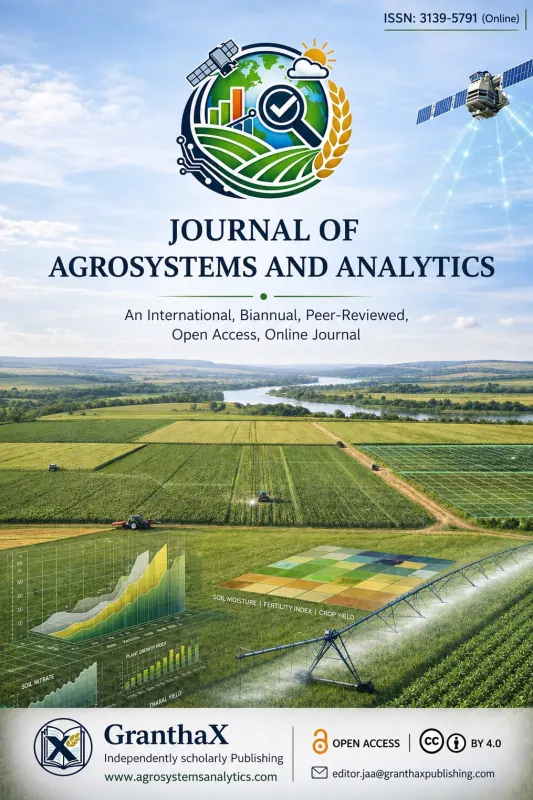
Driving global agricultural digital transformation, the journal publishes research at the intersection of interdisciplinary agriculture, smart farming, and analytics to advance precision agronomy, innovation, efficiency, resilience, and sustainability.

Important Journal Details

Title:
Journal of Agrosystems and Analytics
Journal Short Name:
JAA
ISSN:
Applied
Year of Establishment:
2026
Frequency of the Publication:
Bi-Annual (2 Issues / year)
Publication Format:
Online
Related Subject:
Agriculture
Language:
English
Editor-in-Chief:
Dr. Neelam Patel
Editorial Board:
Click Here →
Journal Coordinator:
Dr. Maulik Amlani
Phone:
7777925107

Download Forms & Formats

Download Hub

Publisher Details

Responsible Person Name:
Virani Vivek
Name of Publishing body:
GranthaX
Address:
B-04, Balaji Heights, Khalipur Road, Joshipura, Junagadh, Gujarat – 362002, India

Journal Features

Rigorous Peer Review

All submissions undergo thorough evaluation by experts in the field to ensure quality and validity.

Global Reach

Published papers reach an international audience of researchers, academics, and industry professionals.

Rapid Publication

Efficient review process ensures timely publication of accepted papers without compromising quality.

Open Access

All published papers are freely accessible online, maximizing visibility and impact of your research.

Publication Process

1

Prepare Manuscript

Format your paper according to our guidelines

View Guidelines
style="fill: var(--journal-600);"
2

Submit Paper

Upload your manuscript through our system

Submit Now
3

Peer Review

Your paper undergoes expert evaluation

Learn More
4

Publication

Accepted papers are published worldwide

View Publications

Aims & Scope

The Journal of Agrosystems and Analytics is a multidisciplinary, open-access journal covering all branches of agricultural science.

While we welcome high-quality submissions from traditional domains such as Natural Resource Management, Crop Improvement, Crop Protection, and Social Sciences, our core mission is to drive the digital transformation of agriculture.

We prioritize data-driven and computational research that harnesses Remote Sensing & GIS, Crop Simulation Modeling, Artificial Intelligence (AI), and Precision Agriculture to optimize complex Agrosystems.

Know US

Journal of Agrosystems and Analytics (JAA) is a peer-reviewed, open-access, biannual journal published by GranthaX to bridge the gap between traditional agricultural science and modern analytics.

We are new, but not novices. Built by researchers for researchers, we promise a fair 8-week peer review, zero predatory fees, and immediate discoverability via Google Scholar, Crossref, and ROAD.

While we build the history required for NAAS and Scopus indexing, we ensure your work makes an impact from day one.

Join us on the ground floor—where integrity meets innovation.

View All Issues
Cover image for Assessment of Sugarcane Evapotranspiration Across Growing Seasons Utilizing Remote Sensing and pySEBAL Model

Assessment of Sugarcane Evapotranspiration Across Growing Seasons Utilizing Remote Sensing and pySEBAL Model

Dr. M. H. Amlani, B. M. Mote

The experiment explored AET seasonal dynamics of a sugarcane field at the Navsari Agricultural University (NAU) in Navsari using the high-resolution remote sensing to address the deficiency of ground-based micrometeorological instruments, e.g. lysimeters or eddy covariance towers. Surface Energy Balance Algorithm on Land (SEBAL) was run in a Python-GRASS GIS setting that combined Landsat 8 satellite data on land with local weather data. The outputs of SEBAL were checked by comparing the estimates with the cloud-based METRIC-EEFlux algorithm. Phenological measurements using NDVI time-series data monitored the sugarcane growth cycle with the greatest vegetative vigor in June and senescence during the months of November to December. Spatial analysis showed that seasonal AET calculated using SEBAL was between 1459 and 1496 mm. An effective rainfall of 676 mm was taken into consideration to estimate the total irrigation water requirements (IWR) of 783 to 820 mm. Conversely METRIC-EEFlux always gave higher values of AET, with the values falling between 1627 and 1698 mm. The pixel-by-pixel comparison of the two models each day showed a moderate correlation (R2 = 0.63) with a Root Mean square error (RMSE) of 1.40mm/day. SEBAL had a mean error (MBE) of bias of -1.17 mm/day, which shows that it was generally underestimated compared to METRIC-EEFlux. The results notwithstanding these differences in the algorithms, SEBAL is a powerful, well-adjusted tool to measure crop water needs and support sound water management decisions in data deficient areas.

Cover image for Comparative Evaluation of APSIM and CANEGRO Models for Simulating Sugarcane Growth and Yield

Comparative Evaluation of APSIM and CANEGRO Models for Simulating Sugarcane Growth and Yield

Harsh R. Prajapati, B. M. Mote, Nayan Baria

This study investigates the performance of the APSIM and CANEGRO crop models in simulating sugarcane growth and yield under different growing environment and fertilizer application. Field experimental data from the 2023–24 season were employed for model calibration, while validation was conducted using data from the 2024–25 season. During calibration, the CANEGRO model demonstrated limited responsiveness to variations in fertilizer dosage, producing uniform outputs across different nutrient treatments. Model validation results indicate that APSIM outperformed CANEGRO in simulating key agronomic parameters including cane yield, aerial dry biomass, and days to emergence. APSIM achieved a higher coefficient of determination (R² = 0.93), D-index (0.95), and lower RMSE (6.01 t/ha) for cane yield compared to CANEGRO (R² = 0.88, D-index = 0.77, RMSE = 6.29 t/ha).

Cover image for Sensitivity Analysis of the APSIM-Sugar and CANEGRO Sugarcane Growth Simulation Models

Sensitivity Analysis of the APSIM-Sugar and CANEGRO Sugarcane Growth Simulation Models

V. B. Virani, Dr. Bheem Pareek, Dr. Siva K. Balasundram

This study investigates the sensitivity of the APSIM and CANEGRO crop models to key climatic parameters and genetic coefficients in simulating sugarcane growth and yield. Sensitivity analyses to genetic coefficient identified critical genetic parameters influencing crop performance. In the CANEGRO model, MaxPARCE, APFMX, and STKPFMAX were the most influential for yield, biomass, and sucrose content, while LFMAX and SER0 significantly impacted LAI and stalk height. These findings suggest that calibration efforts should prioritize phenological, growth, and yield-related parameters. In contrast, global sensitivity analysis using the APSIM model highlighted RUE4, MSS, and GLN as the most impactful parameters affecting cane yield, commercial cane sugar (CCS), and sucrose accumulation, with RUE and MSS emerging as key contributors to both biomass production and sugar content. Additionally, both models exhibited sensitivity to climatic variables. A rise in temperature resulted in a decline in cane yield, more pronounced in CANEGRO (31.35% reduction at +6 °C) compared to APSIM (15.81%). Increases in solar radiation enhanced cane yield and sucrose dry mass, while reduced radiation had adverse effects. Overall, the findings provide actionable insights for improving model calibration and support cultivar selection and management practices under projected climate change scenarios.

Publication Process

Learn about our 4-step publication process

Submission Guidelines

Review requirements before submitting

Submit Article

Ready to submit your research?

6
Published Articles
22
Active Researchers
246
Countries
N/A
Impact Factor
Whatsapp