


How to Get ISSN and Crossref DOI for a New Agriculture or Smart Farming Journal
How to Get ISSN and Crossref DOI for a New Agriculture or Smart Farming Journal
Agricultural sciences are rapidly evolving. Emerging fields such as precision agriculture, digital farming, agricultural analytics, climate-smart agriculture, remote sensing, and sustainable agrosystems are creating new research opportunities across the world. As a result, universities, research institutions, scientific societies, and independent publishers are increasingly considering launching specialized journals dedicated to agricultural innovation.
However, starting a scholarly journal involves much more than publishing research articles. One of the most critical aspects of launching a credible journal is establishing the proper publishing infrastructure, including obtaining an ISSN (International Standard Serial Number) and implementing Crossref DOI (Digital Object Identifier) services.
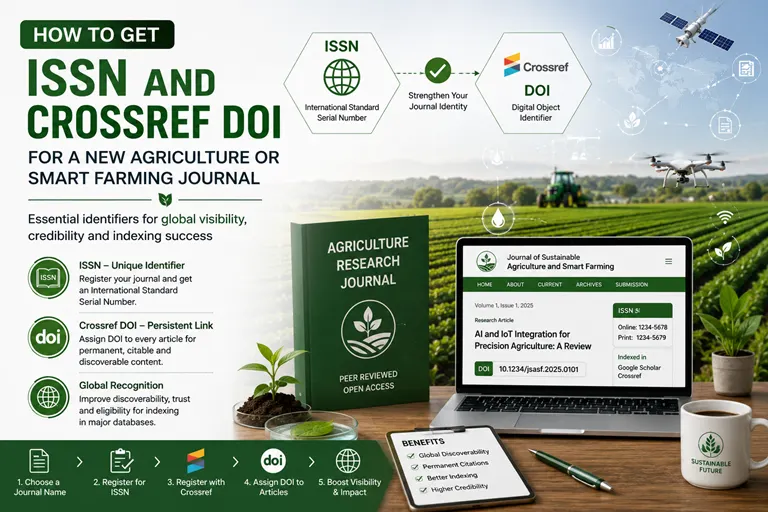
Many journal founders underestimate the importance of these two elements. In reality, ISSN and DOI are essential building blocks that contribute significantly to a journal's professional identity, discoverability, and long-term sustainability.
This guide explains how new agriculture and smart farming journals can obtain ISSN and Crossref DOI and prepare for successful scholarly publishing.
Why ISSN and DOI Matter for Agricultural Journals
Agricultural research is increasingly global and interdisciplinary. Researchers expect journals to maintain professional publishing standards that support:
- Article discoverability
- Citation tracking
- Long-term accessibility
- Indexing readiness
- Research credibility
- International visibility
Both ISSN and DOI play an important role in achieving these objectives.
Without proper identifiers, journals often face challenges in:
- Building author confidence
- Applying for indexing services
- Managing article metadata
- Tracking citations
- Establishing publishing credibility
Understanding ISSN
What Is an ISSN?
An ISSN, or International Standard Serial Number, is an internationally recognized eight-digit identifier assigned to serial publications such as:
- Academic journals
- Magazines
- Annual reports
- Continuing scholarly publications
An ISSN uniquely identifies the journal itself rather than individual articles.
Example:
ISSN: 1234-5678
Most modern journals maintain:
- Online ISSN (e-ISSN)
- Print ISSN (if printed editions exist)
For digital-only agricultural journals, obtaining an online ISSN is usually sufficient.
Why an Agriculture Journal Needs an ISSN
An ISSN helps establish a journal's identity and supports:
Professional Recognition
Authors prefer publishing in journals with recognized publishing infrastructure.
Database Identification
Many indexing services use ISSN as a primary identifier.
Library Cataloguing
Libraries and repositories require ISSN information.
Publishing Credibility
ISSN demonstrates that the journal is operating as a recognized serial publication.
International Visibility
ISSN helps journals become more discoverable in scholarly databases.
Requirements Before Applying for an ISSN
Many new journal founders attempt to apply for an ISSN too early. Most ISSN agencies require that the journal already has an operational website and essential publishing information.
Typical requirements include:
- Journal title
- Journal website
- About Journal page
- Aims and Scope
- Editorial Board
- Publication Ethics statement
- Peer Review Policy
- Author Guidelines
- Contact Information
- Publishing Frequency
- Copyright Policy
- Privacy Policy
- Archive structure
For agriculture and smart farming journals, it is also beneficial to clearly define the journal's subject focus, such as:
- Precision agriculture
- Agricultural engineering
- Agrosystems analytics
- Climate-smart agriculture
- Sustainable farming
- Crop science
- Agricultural informatics
Step-by-Step Process to Obtain an ISSN
Step 1: Finalize the Journal's Scope and Identity
Define:
- Journal title
- Subject area
- Publication frequency
- Editorial policies
- Publishing model
Step 2: Develop the Journal Website
A professional website should contain:
- Journal information pages
- Submission system
- Editorial information
- Archive structure
- Publication policies
Step 3: Prepare Required Documentation
Gather all information required by the national ISSN centre.
Step 4: Submit the ISSN Application
Submit the application according to the requirements of your country's ISSN agency.
Step 5: Await Evaluation
The ISSN agency reviews the application and verifies whether the journal meets the necessary requirements.
Step 6: Receive ISSN Allocation
Once approved, the journal receives its ISSN number.
Common Reasons ISSN Applications Are Delayed
Many applications experience delays because:
- The website is incomplete.
- Editorial information is missing.
- Publication policies are unclear.
- Contact details are insufficient.
- Journal scope is not properly defined.
- Essential pages are absent.
Careful preparation can significantly improve the chances of successful approval.
Need Help with ISSN Consulting?
Launching a journal requires much more than filling out an application form.
OJSCloud provides professional support for:
- Journal website development
- Journal launch consulting
- ISSN readiness assessment
- Publishing infrastructure planning
- OJS support and migration
- Editorial workflow setup
We can help with:
- New journal setup
- Agriculture and smart farming journal launch
- ISSN consulting
- Website readiness assessment
- Publishing guidance
WhatsApp: +91 82003 85143
Email: inquiry@ojscloud.com
Understanding Crossref DOI
What Is a DOI?
A DOI, or Digital Object Identifier, is a permanent identifier assigned to individual scholarly works such as:
- Research articles
- Review papers
- Editorials
- Conference proceedings
- Data papers
Example:
10.1234/jaa.2026.001
Unlike website URLs, DOIs remain persistent even if website addresses change.
Why Agricultural Journals Need DOI Registration
Modern scholarly publishing depends heavily on DOI infrastructure.
DOIs provide:
Persistent Article Identification
Articles remain discoverable over the long term.
Citation Tracking
Citation systems rely heavily on DOI metadata.
Better Indexing Readiness
Many databases prefer journals that maintain proper DOI infrastructure.
Improved Research Visibility
DOIs increase discoverability and accessibility.
Metadata Distribution
Crossref distributes article metadata globally.
International Publishing Standards
DOI registration demonstrates professional publishing practices.
What Is Crossref?
Crossref is one of the world's leading DOI registration agencies for scholarly publishing.
Crossref supports:
- DOI registration
- Metadata management
- Reference linking
- Citation services
- Similarity checking integrations
- Research infrastructure services
Today, most reputable journals assign DOIs to all published articles.
How to Get Crossref DOI for Your Journal
Step 1: Establish the Journal Infrastructure
Before DOI implementation, your journal should have:
- Functional website
- ISSN or ISSN application in progress
- Publication policies
- Editorial workflow
- Metadata standards
Step 2: Determine DOI Registration Pathway
A journal may:
- Become a Crossref member directly.
- Work through a sponsoring organization.
- Use professional DOI support services.
Step 3: Prepare Metadata
Metadata generally includes:
- Article title
- Authors
- Affiliations
- Abstract
- Publication dates
- References
- ORCID information
- URLs
Step 4: Register DOI Prefix and Workflows
Proper DOI workflows should be established before publishing articles.
Step 5: Deposit Metadata
Metadata is deposited and DOIs become active.
Why DOI Planning Should Begin Early
Many new journals wait until after publication to think about DOI registration.
This can lead to:
- Workflow confusion
- Metadata errors
- Delays in indexing applications
- Citation tracking issues
Planning DOI infrastructure from the beginning significantly improves long-term publishing efficiency.
Need Help with Crossref DOI Support?
GetDOI assists journals with:
- Crossref DOI guidance
- Metadata preparation
- DOI workflow setup
- DOI implementation support
- Publishing infrastructure consultation
We can help with:
- New journal DOI planning
- Metadata preparation
- Crossref workflow guidance
- DOI implementation support
WhatsApp: +91 82003 85143
Email: inquiry@ojscloud.com
Building a Complete Publishing Infrastructure
ISSN and DOI are only two parts of the publishing ecosystem.
New agricultural journals also need:
- Professional journal website
- Manuscript submission system
- Editorial workflow management
- Reviewer management
- Publication archiving
- Search engine optimization
- Metadata standards
- Indexing readiness
A strong publishing infrastructure significantly improves a journal's ability to attract quality submissions.
Why Modern Journal Platforms Matter
Many new agricultural journals initially focus only on website creation and later discover the complexity of managing submissions and editorial workflows.
ScholarJMS provides:
- Journal website development
- Manuscript submission system
- Editorial workflow management
- Reviewer management
- Article publishing workflow
- Publishing support services
Integrated publishing solutions help editors focus on scientific quality rather than technical administration.
Planning an Agriculture Journal in 2026
Agricultural research is increasingly driven by:
- Precision agriculture
- Artificial intelligence
- Agricultural analytics
- Climate-smart farming
- Sustainable agrosystems
- Remote sensing technologies
As these fields continue to expand, there is growing demand for specialized journals that serve emerging research communities.
However, long-term success depends on building the journal correctly from the beginning.
A professionally managed publishing infrastructure supported by proper ISSN and DOI implementation provides a strong foundation for future growth.
Frequently Asked Questions
Can I apply for an ISSN before creating a journal website?
Most ISSN agencies expect the journal website and publishing information to be available before evaluation.
Is ISSN mandatory for a journal?
Although not legally mandatory in all countries, an ISSN is highly recommended and often essential for credibility and indexing readiness.
Can a journal obtain DOI without an ISSN?
In some situations it may be possible, but having an ISSN and complete publishing infrastructure generally strengthens the process.
Is Crossref DOI necessary for agricultural journals?
DOIs significantly improve discoverability, citation tracking, and long-term accessibility.
Can small institutions launch their own journals?
Yes. Universities, colleges, societies, and independent publishers can successfully launch scholarly journals with proper planning and infrastructure.
Can external consultants help with journal setup?
Yes. Professional support services can assist with website development, ISSN readiness, DOI planning, and editorial workflow implementation.
Conclusion
Launching an agriculture or smart farming journal requires careful planning and a strong publishing foundation. Obtaining an ISSN and implementing Crossref DOI services are among the most important steps in establishing a credible and discoverable scholarly journal.
ISSN provides the journal with a recognized international identity, while DOI infrastructure ensures that individual articles remain accessible, citable, and professionally managed.
As agricultural research becomes increasingly global and interdisciplinary, journals that invest in proper publishing infrastructure from the beginning are better positioned for long-term success.
Whether you are planning a new journal on precision agriculture, climate-smart farming, agricultural engineering, or sustainable agrosystems, building a robust publishing framework will significantly improve your journal's credibility and future growth.
Final Publishing Support CTA
Need help launching or upgrading your journal?
We can help with:
- Journal website setup
- ScholarJMS implementation
- OJS migration
- ISSN consulting
- Crossref DOI support
- Editorial workflow setup
- Agriculture journal launch guidance
WhatsApp: +91 82003 85143
WhatsApp Direct: https://wa.me/918200385143
Email: inquiry@ojscloud.com