

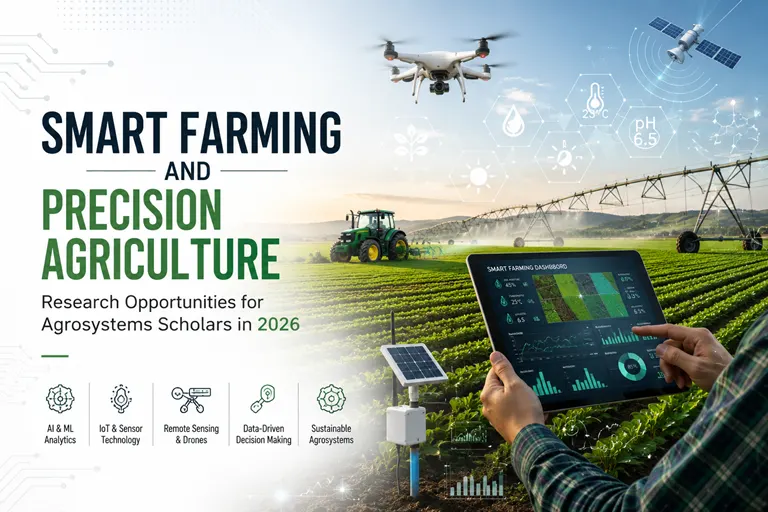
Smart Farming and Precision Agriculture: Research Opportunities for Agrosystems Scholars in 2026
Smart Farming and Precision Agriculture: Research Opportunities for Agrosystems Scholars in 2026
Agriculture is undergoing a profound transformation. The increasing pressure to feed a growing global population, address climate change, improve resource efficiency, and enhance agricultural sustainability has accelerated the adoption of digital technologies in farming systems. Smart farming and precision agriculture have emerged as major drivers of this transformation, enabling farmers and researchers to make data-driven decisions that improve productivity while reducing environmental impacts.
The integration of artificial intelligence, Internet of Things technologies, remote sensing, geospatial analytics, and predictive modeling is creating new opportunities for researchers across agricultural disciplines. These developments are also opening new avenues for interdisciplinary research in agrosystems science, where agronomy, engineering, environmental science, and data analytics converge.
The Journal of Agrosystems and Analytics (JAA) recognizes the growing importance of smart agriculture and aims to provide a scholarly platform for researchers working on innovative solutions that contribute to sustainable and resilient agrosystems.
The Evolution of Smart Farming
Smart farming refers to the application of modern information technologies and data-driven approaches to agricultural production systems. Unlike traditional farming practices that rely heavily on manual observations and generalized management recommendations, smart farming uses real-time data and advanced analytics to optimize decision-making.
Modern smart farming systems incorporate:
- Precision irrigation technologies
- Sensor-based crop monitoring
- Drone and satellite imagery
- Artificial intelligence and machine learning
- Agricultural robotics
- Geographic Information Systems (GIS)
- Internet of Things (IoT) devices
- Climate and yield forecasting systems
These technologies are helping agricultural systems become more productive, efficient, and environmentally sustainable.
Why Precision Agriculture Matters in 2026
Agriculture faces several critical challenges:
- Climate variability and extreme weather events
- Water scarcity
- Soil degradation
- Rising input costs
- Labour shortages
- Increasing demand for food security
- Environmental sustainability concerns
Precision agriculture provides solutions by enabling site-specific management practices that optimize the use of resources such as water, fertilizers, pesticides, and energy.
By utilizing data and advanced technologies, farmers can:
- Improve crop yields
- Reduce production costs
- Minimize environmental impacts
- Enhance profitability
- Increase resilience against climate change
As governments and institutions worldwide invest in digital agriculture initiatives, research opportunities in this area continue to expand.
Emerging Research Opportunities in Smart Farming and Precision Agriculture
Artificial Intelligence and Machine Learning in Agriculture
Artificial intelligence is rapidly becoming one of the most influential technologies in agriculture.
Current research areas include:
- Crop disease detection using image processing
- Yield prediction models
- Automated weed identification
- Pest forecasting systems
- Precision nutrient management
- Smart greenhouse management
- Decision support systems for farmers
Machine learning algorithms can process massive agricultural datasets and identify patterns that would be difficult to detect using traditional approaches.
Researchers can contribute by developing:
- Explainable AI models for agriculture
- Region-specific predictive systems
- AI-based crop recommendation engines
- Agricultural risk assessment models
Internet of Things in Agricultural Systems
IoT technologies enable continuous monitoring of farming conditions.
Research areas include:
- Soil moisture sensing
- Smart irrigation systems
- Livestock monitoring
- Environmental monitoring systems
- Connected farm management platforms
- Real-time crop health monitoring
IoT-based systems generate valuable datasets that can be integrated with analytics platforms to improve agricultural decision-making.
Future research can focus on:
- Low-cost sensor development
- Energy-efficient agricultural devices
- IoT interoperability standards
- Data security and privacy in agricultural systems
Remote Sensing and Drone-Based Agriculture
Satellite and drone technologies are transforming crop monitoring.
Research opportunities include:
- Crop health assessment
- Early disease detection
- Nutrient deficiency mapping
- Biomass estimation
- Precision spraying systems
- Yield forecasting
- Water stress assessment
High-resolution imagery combined with artificial intelligence can significantly improve precision agriculture practices.
Researchers are increasingly exploring multispectral and hyperspectral imaging technologies to enhance crop management decisions.
Geographic Information Systems and Spatial Analytics
GIS plays a crucial role in precision agriculture.
Research topics include:
- Soil mapping
- Land suitability analysis
- Spatial variability assessment
- Climate vulnerability mapping
- Precision nutrient management
- Agricultural zoning
Spatial analytics can help policymakers and farmers make informed decisions regarding land use and agricultural planning.
Big Data Analytics in Agriculture
Agriculture generates enormous amounts of data from sensors, weather stations, machinery, satellite imagery, and farm management systems.
Research opportunities include:
- Agricultural data integration frameworks
- Predictive analytics models
- Real-time decision support systems
- Farm data management platforms
- Agricultural knowledge graphs
- Data-driven sustainability assessments
The ability to convert agricultural data into actionable insights represents one of the most promising areas of agrosystems research.
Climate-Smart Agriculture and Sustainability Analytics
Climate change is influencing agricultural productivity worldwide.
Research opportunities include:
- Carbon-smart farming systems
- Climate adaptation strategies
- Sustainable resource management
- Water-use efficiency modeling
- Climate risk assessment
- Greenhouse gas emission studies
Smart farming technologies can significantly contribute to achieving sustainable development goals related to food security and environmental protection.
Precision Agriculture Research Areas with High Publication Potential
The following research themes are likely to receive significant scholarly attention in 2026:
Smart Irrigation Systems
Research on sensor-based irrigation scheduling, water-saving technologies, and predictive irrigation models.
Precision Nutrient Management
Studies focusing on site-specific fertilizer recommendations and nutrient optimization.
Agricultural Robotics
Development of autonomous machines for harvesting, spraying, and crop monitoring.
Digital Twins in Agriculture
Virtual simulation models for crop production and farm management.
Blockchain and Agricultural Traceability
Research on food supply chain transparency and agricultural data integrity.
Smart Greenhouse Systems
Automation technologies for controlled environment agriculture.
Agricultural Decision Support Systems
Data-driven tools that assist farmers in making informed management decisions.
Predictive Analytics for Crop Production
Yield prediction and risk forecasting models using machine learning techniques.
Interdisciplinary Research Opportunities in Agrosystems Science
One of the defining characteristics of smart farming research is its interdisciplinary nature.
Potential collaborations include:
- Agriculture and computer science
- Agronomy and engineering
- Environmental science and data analytics
- Agricultural economics and information technology
- Soil science and remote sensing
- Plant pathology and artificial intelligence
Interdisciplinary research often produces innovative solutions that have both scientific and practical significance.
Publication Opportunities for Researchers
The rapid expansion of digital agriculture has created significant demand for high-quality scholarly publications.
The Journal of Agrosystems and Analytics (JAA) welcomes original research contributions in areas such as:
- Precision agriculture
- Smart farming technologies
- Agricultural data analytics
- Remote sensing applications
- GIS and spatial modeling
- Artificial intelligence in agriculture
- Climate-smart agriculture
- Sustainable agrosystems
- Agricultural informatics
- Digital transformation in farming systems
Researchers, doctoral scholars, and practitioners working in these areas are encouraged to contribute to the growing body of knowledge in agricultural analytics and sustainable farming systems.
Challenges and Future Directions
Despite significant advancements, several challenges remain:
Technology Accessibility
Many farmers still lack access to advanced digital technologies.
Data Standardization
Agricultural data often exists in fragmented formats.
Infrastructure Limitations
Connectivity and technological infrastructure remain inadequate in certain regions.
Capacity Building
Farmers and agricultural professionals require digital skills and training.
Policy and Governance
Effective policies are necessary to support digital agriculture adoption.
Future research should focus on developing scalable, affordable, and inclusive technologies that can benefit agricultural systems globally.
Frequently Asked Questions
What is smart farming?
Smart farming refers to the use of digital technologies, sensors, analytics, and artificial intelligence to improve agricultural productivity and sustainability.
What is precision agriculture?
Precision agriculture is a farming management approach that uses data and technology to optimize resource use and improve crop performance.
Why is precision agriculture important?
It improves efficiency, reduces costs, enhances sustainability, and supports climate-resilient farming systems.
Which technologies are driving smart farming?
Artificial intelligence, IoT, remote sensing, drones, GIS, big data analytics, robotics, and predictive modeling.
What are the major research opportunities in digital agriculture?
Crop monitoring, yield prediction, climate-smart farming, agricultural analytics, decision support systems, and smart irrigation technologies.
Where can researchers publish smart farming research?
Researchers can publish in specialized journals focusing on agricultural systems, precision agriculture, and digital agriculture, including the Journal of Agrosystems and Analytics.
Conclusion
Smart farming and precision agriculture are reshaping the future of global agriculture. The integration of advanced technologies and data-driven approaches is creating unprecedented opportunities for researchers, institutions, and practitioners.
As agriculture faces increasingly complex challenges related to food security, sustainability, and climate change, innovative research in digital agriculture will play a critical role in developing resilient and efficient farming systems.
The Journal of Agrosystems and Analytics seeks to support this scientific transformation by providing a platform for publishing high-quality research that advances smart farming, agricultural analytics, and sustainable agrosystems.
Researchers working in precision agriculture, digital farming technologies, artificial intelligence, remote sensing, and agricultural data science are encouraged to contribute their findings and participate in shaping the future of agricultural innovation.