

OJS vs ScholarJMS: Which Platform Is Better for New Agricultural Research Journals?
OJS vs ScholarJMS: Which Platform Is Better for New Agricultural Research Journals?
Launching an agricultural research journal has become more accessible than ever before. Universities, agricultural colleges, research institutes, scientific societies, and independent publishers are increasingly establishing specialized journals dedicated to precision agriculture, agrosystems science, crop analytics, climate-smart farming, agricultural engineering, and sustainable food systems.
However, one of the most important decisions for a new journal is selecting the right journal management platform.
The platform chosen at the beginning often determines:
- The efficiency of manuscript submission and peer review.
- Editorial workload and turnaround time.
- Author and reviewer experience.
- Long-term scalability.
- Indexing readiness.
- DOI management and publication workflows.
- Overall journal reputation.
For many years, the most common choice has been the Open Journal Systems (OJS) platform. Recently, modern cloud-based publishing solutions such as ScholarJMS have emerged to address the growing needs of scholarly publishers.
This article compares OJS and ScholarJMS specifically from the perspective of agricultural research journals and provides practical guidance for editors and publishers planning to launch or modernize their journals.
Why Agricultural Research Journals Need a Modern Publishing Platform
Agricultural research has become increasingly interdisciplinary.
Modern agricultural journals frequently publish studies involving:
- Artificial intelligence in agriculture
- Remote sensing and GIS
- Big data analytics
- Crop modeling
- Climate-smart agriculture
- Agricultural biotechnology
- Precision farming technologies
- Sustainable agrosystems research
These fields often involve:
- Multiple authors from different countries
- Large supplementary datasets
- Extensive peer review processes
- Complex editorial workflows
- High expectations regarding publication speed
As a result, agricultural journals require publishing systems that are efficient, scalable, and user-friendly.
Understanding Open Journal Systems (OJS)
What is OJS?
Open Journal Systems (OJS) is an open-source journal publishing platform developed by the Public Knowledge Project.
It provides:
- Journal website management
- Manuscript submission
- Editorial workflows
- Peer review management
- Publication management
- Basic indexing tools
OJS has become one of the most widely used journal management systems globally because it is free and highly customizable.
Advantages of OJS
No Software Licensing Cost
The software itself is free to download and use.
Large Global Community
Thousands of journals use OJS, creating a large user community and extensive documentation.
Flexible Customization
Developers can customize the platform according to institutional requirements.
Plugin Ecosystem
Several plugins support:
- DOI registration
- ORCID integration
- Metadata export
- Citation management
- Indexing tools
Challenges of OJS for New Agricultural Journals
Despite its popularity, many new agricultural journals face challenges when implementing OJS.
Technical Complexity
OJS installation requires:
- Hosting setup
- Server management
- Security updates
- Plugin management
- Database administration
Many editorial teams lack dedicated technical staff.
Maintenance Burden
OJS requires:
- Regular software updates
- Plugin compatibility checks
- Backup management
- Security monitoring
These tasks consume valuable time and resources.
User Experience Challenges
Some users find the interface:
- Less intuitive
- More complex for first-time authors
- Difficult for reviewers unfamiliar with scholarly systems
Custom Development Costs
Although OJS is free, customization often requires:
- Professional developers
- Design modifications
- Technical consultants
- Long-term maintenance contracts
The total cost of ownership may become significant.
Limited End-to-End Publishing Support
OJS primarily provides software.
Editors still need external assistance for:
- Journal launch consulting
- ISSN readiness
- DOI workflows
- Website development
- Publishing strategy
- Technical support
What is ScholarJMS?
ScholarJMS is a modern cloud-based journal management platform designed to simplify scholarly publishing for journals, publishers, universities, and professional societies.
It combines:
- Journal website development
- Manuscript submission system
- Editorial workflow management
- Peer review management
- Article publication workflow
- Editorial communication tools
- Publishing support services
ScholarJMS is particularly attractive for emerging journals that want professional publishing infrastructure without technical complexity.
Why Agricultural Journals Are Choosing ScholarJMS
Ready-to-Launch Infrastructure
New agricultural journals can begin operations without:
- Server management
- Software installation
- Plugin configuration
- Technical maintenance
This allows editors to focus on scientific quality rather than software administration.
User-Friendly Editorial Workflow
The platform is designed to simplify:
- Author submission
- Reviewer invitations
- Editorial decisions
- Production tracking
- Publication management
A streamlined workflow can significantly reduce editorial delays.
Professional Journal Website
Agricultural journals increasingly require:
- Modern website design
- Mobile responsiveness
- Search engine optimization
- Better user experience
- Professional branding
ScholarJMS offers integrated journal website development alongside workflow management.
Publishing Support Services
One of the biggest advantages of ScholarJMS is the availability of publishing support services that extend beyond software.
This includes assistance with:
- Journal launch planning
- Workflow setup
- Publishing consultation
- Technical guidance
- Journal growth strategies
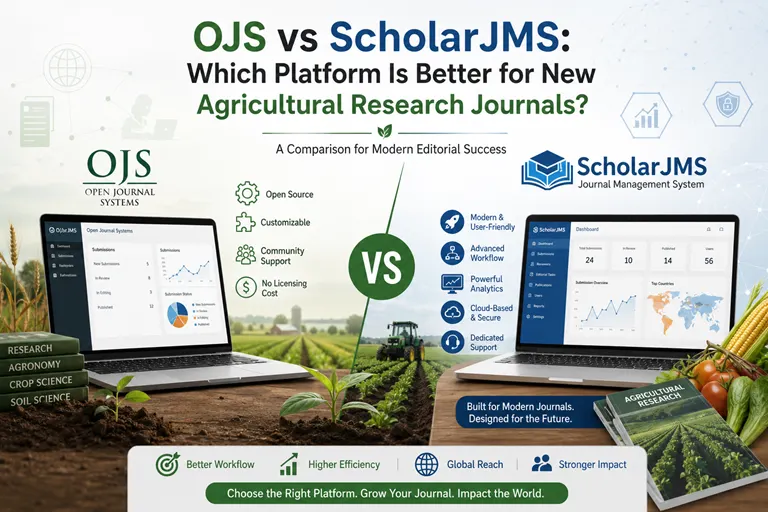
OJS vs ScholarJMS: Feature Comparison
| Feature | OJS | ScholarJMS |
|---|---|---|
| Software Installation | Required | Not Required |
| Server Management | Required | Managed |
| Technical Maintenance | Required | Managed |
| Journal Website Setup | Custom Development | Included |
| Editorial Workflow | Available | Modernized Workflow |
| User Experience | Moderate Learning Curve | User-Friendly |
| Mobile Optimization | Depends on Theme | Built In |
| Publishing Consultation | External | Available |
| Journal Launch Support | Limited | Available |
| Ongoing Technical Support | Variable | Dedicated Support |
| Scalability | Depends on Hosting | Cloud-Based |
| New Journal Setup Speed | Moderate | Fast |
Which Platform Is Better for New Agricultural Research Journals?
The answer depends on the needs and resources of the journal.
OJS May Be Suitable If:
- The institution already has technical staff.
- The journal has in-house developers.
- The budget is highly constrained.
- The institution prefers complete technical control.
ScholarJMS May Be Suitable If:
- The journal wants a ready-to-launch solution.
- Editors prefer to focus on publishing rather than technology.
- Technical support is limited.
- Professional workflow management is required.
- The journal needs long-term publishing guidance.
For many new agricultural journals, the availability of integrated support and simplified workflows can significantly accelerate journal development.
ISSN Readiness and Journal Launch Support
One of the most overlooked aspects of starting a journal is obtaining ISSN and ensuring that the journal website meets publishing readiness requirements.
Many editors discover that launching a journal involves much more than installing software.
Requirements often include:
- Journal policies
- Editorial board structure
- Publication ethics statements
- Author guidelines
- Website completeness
- Metadata standards
OJSCloud provides support for:
- Journal launch consulting
- OJS hosting and support
- ISSN consulting
- Publishing readiness assessments
- OJS migration services
- Journal website development
Why Crossref DOI Planning Matters
Modern scholarly publishing increasingly depends on persistent identifiers.
Crossref DOI registration supports:
- Citation tracking
- Long-term discoverability
- Metadata distribution
- Indexing readiness
- Digital preservation
Many journals struggle with:
- Crossref membership requirements
- Metadata preparation
- DOI workflows
- Technical implementation
GetDOI assists journals with:
- Crossref DOI guidance
- DOI workflow setup
- Metadata preparation
- DOI implementation support
CTA: Need Help Launching or Upgrading Your Journal?
We can help with:
- ScholarJMS journal website setup
- OJS migration services
- ISSN consulting
- Crossref DOI support
- Editorial workflow setup
- Agricultural journal launch guidance
WhatsApp: +91 82003 85143
Email: inquiry@ojscloud.com
Migrating an Existing OJS Journal
Many agricultural journals already using OJS eventually decide to modernize their publishing infrastructure.
Common reasons include:
- Better workflow management
- Improved website experience
- Reduced maintenance burden
- Professional technical support
- Scalability requirements
Migration planning should consider:
- Article metadata
- DOI preservation
- Author accounts
- Editorial workflows
- Search engine visibility
A carefully managed migration can significantly improve operational efficiency without disrupting journal continuity.
The Future of Agricultural Journal Publishing
Agricultural science is becoming increasingly data-driven and globally collaborative.
Future journals will likely require:
- Faster editorial processes
- Better author experiences
- Strong metadata management
- Transparent peer review systems
- Scalable digital infrastructure
- Enhanced discoverability
Publishing platforms must evolve to support these changing requirements.
Platforms that combine technology with publishing expertise are likely to play an increasingly important role in scholarly communication.
Building Trust Through Transparent Publishing
The future of scholarly publishing also involves greater transparency and research integrity.
Scholar9 supports the development of transparent peer review ecosystems and research trust initiatives that can help journals strengthen their credibility and academic reputation.
For agricultural journals seeking international visibility, building trust and maintaining high editorial standards remain essential priorities.
CTA: Planning to Start an Agricultural Research Journal?
Whether you are launching a new journal or modernizing an existing publication, professional guidance can save significant time and resources.
Support is available for:
- New journal website development
- OJS to ScholarJMS migration
- ISSN consulting
- Crossref DOI implementation
- Editorial workflow design
- Publishing strategy and launch guidance
WhatsApp: +91 82003 85143
Email: inquiry@ojscloud.com
Frequently Asked Questions
Is OJS free?
Yes. OJS is open-source software and can be downloaded without licensing fees, although hosting, customization, and maintenance costs may still apply.
Is ScholarJMS suitable for new journals?
Yes. ScholarJMS is particularly suitable for emerging journals that require an integrated journal website and editorial workflow platform.
Can an agricultural journal migrate from OJS to ScholarJMS?
Yes. Existing journals can migrate their workflows and publishing infrastructure with proper planning and technical support.
Does a journal need DOI registration?
DOIs significantly improve article discoverability, citation tracking, and indexing readiness.
Can journals receive support for ISSN applications?
Yes. Publishing consultancy services can assist journals in preparing for ISSN applications and website readiness requirements.
Which platform is better for editors without technical staff?
Cloud-based platforms with integrated support services are often easier to manage for editorial teams without dedicated technical personnel.
Conclusion
Selecting the right journal management platform is one of the most important strategic decisions for any new agricultural research journal.
Open Journal Systems remains a valuable and widely adopted solution, particularly for institutions with strong technical capabilities. However, many emerging agricultural journals now require more than software alone. They need integrated publishing support, modern workflows, professional websites, and long-term guidance.
ScholarJMS offers an alternative approach by combining journal technology with publishing expertise, enabling editors and publishers to focus on scientific quality and journal growth rather than technical administration.
As agricultural research becomes increasingly interdisciplinary and digitally connected, the publishing platforms supporting scholarly communication must evolve accordingly. Choosing a platform that aligns with a journal's resources, objectives, and long-term vision can significantly influence its future success.