


How to Start an Online Agricultural Science Journal in 2026: Website, ISSN, DOI, Peer Review and Indexing Checklist
How to Start an Online Agricultural Science Journal in 2026: Website, ISSN, DOI, Peer Review and Indexing Checklist
Agriculture is undergoing a remarkable transformation. Emerging areas such as precision agriculture, artificial intelligence in farming, climate-smart agriculture, agricultural analytics, remote sensing, sustainable agrosystems, and digital farming are creating entirely new research communities across the world.
As the volume of agricultural research continues to grow, universities, agricultural colleges, scientific societies, government institutions, and independent publishers are increasingly exploring the idea of launching specialized scholarly journals.
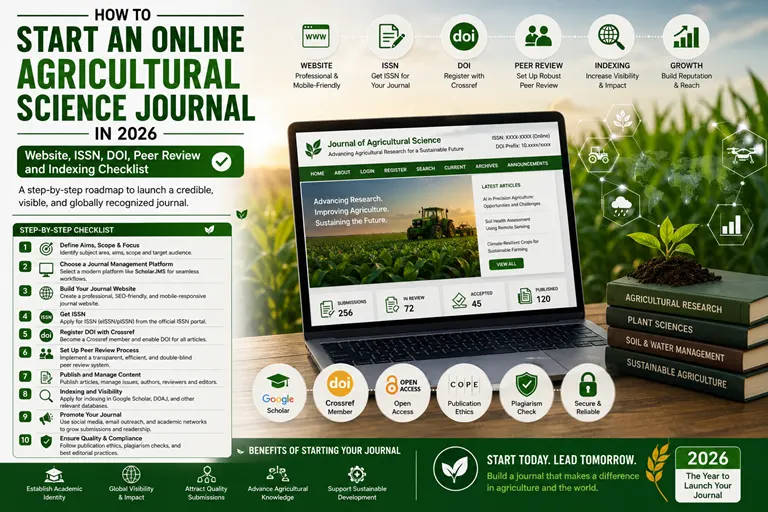
Starting an online agricultural science journal has become more accessible than ever before. However, establishing a credible and sustainable journal requires much more than simply creating a website and publishing research papers.
A successful journal needs:
- A clearly defined scope
- A professional journal website
- ISSN registration
- Crossref DOI implementation
- A robust peer review system
- Publication ethics policies
- Editorial workflows
- Long-term indexing readiness
This guide provides a practical roadmap for launching an agricultural science journal in 2026.
Why Start an Agricultural Science Journal?
Agriculture is becoming increasingly interdisciplinary and technology-driven. Many emerging fields still have limited publication opportunities.
Examples include:
- Smart farming
- Agricultural analytics
- Digital agriculture
- Climate-resilient agriculture
- Agricultural artificial intelligence
- Precision irrigation
- Carbon farming
- Sustainable agrosystems
- Agricultural data science
Launching a specialized journal can:
- Create a dedicated platform for emerging research areas.
- Support regional and international research communities.
- Encourage interdisciplinary collaboration.
- Increase institutional visibility.
- Contribute to scientific advancement.
However, long-term success depends on building the journal correctly from the beginning.
Step 1: Define the Journal's Scope and Vision
The first step is establishing the journal's academic identity.
Questions to consider include:
What subject areas will the journal cover?
Possible areas include:
- Agronomy
- Crop science
- Agricultural engineering
- Precision agriculture
- Soil science
- Climate-smart agriculture
- Agricultural economics
- Sustainable farming systems
Who is the target audience?
Potential audiences include:
- Researchers
- Universities
- Extension professionals
- Policymakers
- Industry experts
- Doctoral scholars
What type of manuscripts will be accepted?
Examples:
- Original research articles
- Review papers
- Short communications
- Case studies
- Technical notes
- Data papers
A clearly defined scope helps attract the right authors and readers.
Step 2: Choose a Journal Name and Publishing Model
The journal title should:
- Reflect the subject area.
- Be unique and memorable.
- Avoid confusion with existing journals.
- Support long-term branding.
Next, determine the publishing model:
- Open Access
- Subscription-Based
- Hybrid Publishing
Most new agricultural journals choose an open-access model because it improves visibility and accessibility.
Step 3: Build a Professional Journal Website
A journal website is the public face of the publication.
A professional website should include:
Essential Pages
- Home
- About Journal
- Aims and Scope
- Editorial Board
- Instructions for Authors
- Publication Ethics
- Peer Review Policy
- Current Issue
- Archives
- Contact Us
- Submit Manuscript
Additional Features
- Mobile responsiveness
- Search engine optimization
- Secure hosting
- Metadata support
- Author dashboards
- Reviewer management
A poorly designed website can significantly reduce author confidence.
Why Modern Journal Platforms Matter
Many journals initially rely on basic websites and later struggle with manuscript management.
Modern publishing platforms combine:
- Website development
- Submission management
- Peer review systems
- Editorial workflows
- Publication management
- Technical support
ScholarJMS provides integrated journal website development and manuscript management solutions specifically designed for scholarly publishing.
Step 4: Establish Editorial Policies
Before accepting submissions, the journal should establish clear policies regarding:
Publication Ethics
- Plagiarism policies
- Conflict of interest statements
- Retraction procedures
- Research misconduct policies
Copyright and Licensing
- Copyright ownership
- Licensing models
- Open access policies
Peer Review Process
- Double-blind review
- Single-blind review
- Open peer review
Well-defined policies improve transparency and credibility.
Step 5: Build the Editorial Board
A strong editorial board is essential.
Consider including experts from:
- Agronomy
- Crop science
- Agricultural engineering
- Environmental science
- Agricultural economics
- Precision agriculture
- Soil science
- Climate science
International representation significantly improves journal credibility.
Step 6: Obtain ISSN for the Journal
An ISSN (International Standard Serial Number) provides a recognized identity for the journal.
Most new journal founders underestimate the importance of ISSN planning.
Before applying, ensure that the website contains:
- Complete journal information
- Editorial policies
- Contact details
- Publishing frequency
- Editorial board information
- Submission guidelines
Need Help with ISSN Consulting?
OJSCloud provides support for:
- Journal launch consulting
- ISSN readiness assessment
- Journal website development
- OJS support and migration
- Publishing infrastructure planning
We can help with:
- Agriculture journal setup
- ISSN consulting
- Website readiness
- Publishing guidance
WhatsApp: +91 82003 85143
WhatsApp Direct: https://wa.me/918200385143
Email: inquiry@ojscloud.com
Step 7: Implement Crossref DOI Infrastructure
DOIs provide permanent identifiers for individual articles.
Benefits include:
- Better discoverability
- Citation tracking
- Metadata distribution
- International visibility
- Long-term accessibility
Modern journals increasingly depend on DOI infrastructure.
Why DOI Planning Should Begin Early
Many journals delay DOI planning and later encounter challenges involving:
- Metadata preparation
- Workflow implementation
- Indexing readiness
- Citation management
Planning DOI workflows from the beginning simplifies future operations.
Need Help with Crossref DOI Support?
GetDOI assists journals with:
- Crossref DOI guidance
- Metadata preparation
- DOI implementation
- Publishing consultation
- Workflow setup
We can help with:
- DOI planning
- Crossref implementation
- Metadata management
- Publishing support
WhatsApp: +91 82003 85143
Email: inquiry@ojscloud.com
Step 8: Implement a Manuscript Submission and Peer Review System
Manual workflows quickly become inefficient as journals grow.
A modern system should support:
- Author registration
- Manuscript submission
- Reviewer assignment
- Editorial decisions
- Revision management
- Publication workflows
Digital platforms significantly improve editorial efficiency.
Why Peer Review Infrastructure Matters
A robust peer review system:
- Improves scientific quality.
- Enhances credibility.
- Reduces administrative burden.
- Increases transparency.
- Improves author satisfaction.
Modern publishing increasingly depends on efficient and transparent editorial systems.
Step 9: Prepare for Indexing
Many new journals focus on indexing too early.
Indexing agencies usually expect:
- Consistent publishing history
- Strong editorial standards
- Publication ethics
- Metadata quality
- DOI implementation
- Professional website structure
Examples of future indexing goals may include:
- Google Scholar
- Crossref metadata services
- Directory-based databases
- Discipline-specific indexing services
Indexing readiness should be treated as a long-term objective rather than an immediate outcome.
Step 10: Develop a Long-Term Publishing Strategy
Launching the journal is only the beginning.
Long-term success requires:
- Regular publication schedules
- Editorial quality control
- Author engagement
- Marketing strategies
- International collaboration
- Technical maintenance
- Continuous improvement
A strategic vision helps journals achieve sustainable growth.
Agricultural Journal Launch Checklist
Journal Planning
- Define journal scope.
- Choose journal title.
- Determine publishing model.
- Establish policies.
Website Development
- Create professional website.
- Build archive structure.
- Optimize for mobile devices.
- Configure metadata.
Publishing Infrastructure
- Implement submission system.
- Establish peer review workflows.
- Build editorial dashboards.
Journal Registration
- Apply for ISSN.
- Implement DOI workflows.
Editorial Development
- Recruit editorial board.
- Develop reviewer database.
- Prepare author guidelines.
Indexing Readiness
- Establish publishing consistency.
- Maintain metadata quality.
- Build journal visibility.
Why Many New Journals Seek Professional Guidance
Launching a scholarly journal involves:
- Technical planning
- Publishing standards
- Editorial management
- Metadata requirements
- Long-term strategy
Many institutions lack dedicated publishing specialists.
Professional support can significantly reduce risks and accelerate journal development.
Complete Journal Launch Support
Whether you are planning an agricultural journal, a precision farming journal, or a climate-smart agriculture publication, professional guidance can simplify the process.
We can help with:
- Journal website development
- ScholarJMS implementation
- OJS hosting and migration
- ISSN consulting
- Crossref DOI support
- Editorial workflow setup
- Journal launch guidance
- Publishing infrastructure planning
WhatsApp: +91 82003 85143
WhatsApp Direct: https://wa.me/918200385143
Email: inquiry@ojscloud.com
Building Trust Through Transparent Publishing
The future of scholarly publishing increasingly emphasizes:
- Research integrity
- Transparent peer review
- Reviewer recognition
- Editorial accountability
- Ethical publishing practices
Scholar9 supports transparent peer review ecosystems and research trust initiatives that help journals strengthen credibility and build long-term academic reputation.
Frequently Asked Questions
Can an institution start its own agricultural journal?
Yes. Universities, research institutes, scientific societies, and independent publishers can successfully launch scholarly journals.
Is ISSN mandatory?
Although requirements vary by country, obtaining an ISSN is highly recommended for credibility and discoverability.
Does every journal need DOI registration?
DOIs significantly improve citation tracking, discoverability, and professional publishing standards.
Which platform is best for a new journal?
The ideal platform depends on technical resources, editorial requirements, and long-term publishing goals.
How long does it take to launch a journal?
The timeline varies, but careful planning and professional guidance can significantly accelerate the process.
Can external experts help with journal setup?
Yes. Professional publishing support services can assist with website development, ISSN planning, DOI implementation, and editorial workflow design.
Conclusion
Launching an online agricultural science journal in 2026 presents exciting opportunities to support emerging research communities and contribute to scientific advancement.
However, building a successful journal requires much more than publishing articles. Professional infrastructure, including a modern website, ISSN registration, Crossref DOI implementation, robust peer review systems, and long-term indexing readiness, forms the foundation of sustainable scholarly publishing.
As agriculture becomes increasingly interdisciplinary and digitally connected, journals that invest in strong publishing infrastructure from the beginning will be better positioned to achieve credibility, attract quality submissions, and grow internationally.
With proper planning and expert guidance, institutions and publishers can successfully establish agricultural journals that serve researchers and contribute meaningfully to the future of agricultural science.
Final Publishing Support CTA
Planning to launch your agricultural science journal?
We can help with:
- Journal website development
- ScholarJMS implementation
- OJS hosting and migration
- ISSN consulting
- Crossref DOI support
- Manuscript submission systems
- Peer review workflow setup
- Complete journal launch guidance
WhatsApp: +91 82003 85143
WhatsApp Direct: https://wa.me/918200385143
Email: inquiry@ojscloud.com