

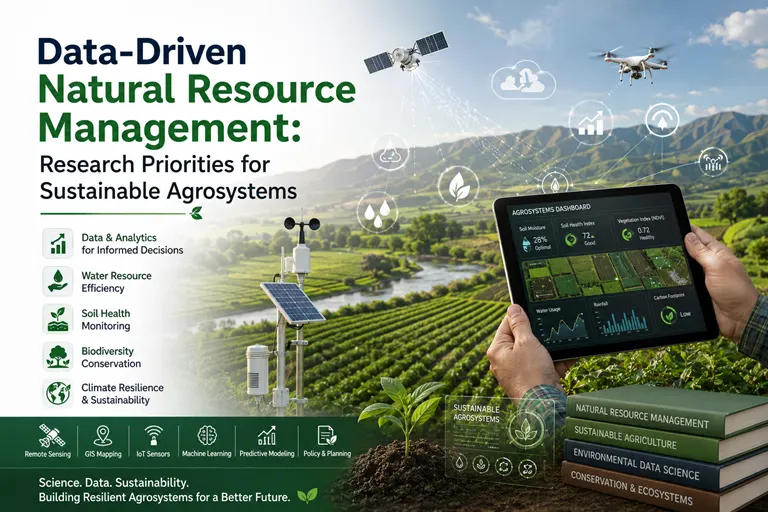
Data-Driven Natural Resource Management: Research Priorities for Sustainable Agrosystems
Data-Driven Natural Resource Management: Research Priorities for Sustainable Agrosystems
Agriculture depends fundamentally on the responsible management of natural resources. Soil, water, biodiversity, forests, climate, and ecosystem services form the foundation of global food systems. However, increasing population pressure, climate variability, land degradation, water scarcity, and unsustainable agricultural practices have created unprecedented challenges for natural resource management.
Traditional approaches to resource management often relied on generalized recommendations and periodic assessments. Today, the rapid growth of digital technologies, big data analytics, remote sensing, and artificial intelligence is enabling a new era of data-driven natural resource management. Researchers now have access to vast amounts of environmental and agricultural data that can be transformed into actionable insights for sustainable development.
For scholars working in agriculture and environmental sciences, this transformation presents significant opportunities to develop innovative solutions that improve productivity while conserving natural resources. The Journal of Agrosystems and Analytics (JAA) recognizes the importance of these emerging research areas and aims to promote interdisciplinary research that supports sustainable and resilient agrosystems.
Why Natural Resource Management Matters More Than Ever
Natural resources are under growing pressure worldwide. Several interconnected challenges are reshaping agricultural systems:
- Declining soil fertility
- Groundwater depletion
- Climate change and extreme weather events
- Biodiversity loss
- Land degradation and desertification
- Pollution from agricultural inputs
- Increasing competition for water resources
- Deforestation and ecosystem disruption
These issues directly affect agricultural productivity, food security, and rural livelihoods.
Sustainable agrosystems require efficient management strategies that balance agricultural production with environmental conservation. Data-driven approaches can help decision-makers identify problems early, optimize resource use, and design long-term sustainability strategies.
The Rise of Data-Driven Natural Resource Management
Data-driven natural resource management refers to the use of digital technologies and analytical methods to monitor, evaluate, and optimize the use of environmental resources.
Modern technologies now enable researchers to collect and analyze information from:
- Satellite imagery
- Remote sensing platforms
- Internet of Things (IoT) devices
- Weather stations
- Soil sensors
- Drone technologies
- Geographic Information Systems (GIS)
- Agricultural databases
- Climate models
- Machine learning systems
The integration of these technologies is transforming the way agricultural systems are managed and studied.
Key Technologies Driving Sustainable Agrosystems Research
Geographic Information Systems and Spatial Analytics
Geographic Information Systems have become essential tools for natural resource management.
Research applications include:
- Soil resource mapping
- Land capability assessment
- Watershed management
- Agricultural zoning
- Land-use planning
- Drought monitoring
- Climate vulnerability assessment
GIS technologies enable researchers to understand spatial variability and support evidence-based decision-making.
Remote Sensing and Earth Observation
Satellite technologies are revolutionizing environmental monitoring.
Major applications include:
- Vegetation monitoring
- Crop condition assessment
- Forest cover analysis
- Soil moisture estimation
- Water resource monitoring
- Land degradation assessment
- Biodiversity monitoring
High-resolution satellite imagery provides valuable information for large-scale resource management initiatives.
Internet of Things in Resource Monitoring
IoT technologies are enabling real-time monitoring of agricultural and environmental conditions.
Research opportunities include:
- Smart irrigation systems
- Soil nutrient monitoring
- Groundwater monitoring
- Climate sensing networks
- Precision water management
- Environmental quality monitoring
The integration of sensor networks with analytical platforms creates opportunities for predictive and adaptive resource management.
Artificial Intelligence and Machine Learning
Artificial intelligence is increasingly being applied to environmental and agricultural datasets.
Research applications include:
- Crop yield forecasting
- Water demand prediction
- Land-use change analysis
- Pest and disease prediction
- Climate risk assessment
- Resource optimization models
- Environmental decision support systems
Machine learning algorithms can identify patterns and relationships that are difficult to detect through conventional analytical approaches.
Big Data Analytics and Decision Support Systems
Agricultural systems generate enormous amounts of data.
Big data analytics can support:
- Resource allocation planning
- Sustainability assessments
- Agricultural forecasting
- Ecosystem service valuation
- Policy development
- Farm-level decision-making
Data-driven decision support systems are becoming increasingly important in sustainable agriculture research.
Major Research Priorities for Sustainable Agrosystems in 2026
Precision Water Resource Management
Water scarcity has become one of the most critical challenges facing agriculture.
Research priorities include:
- Smart irrigation scheduling
- Groundwater sustainability assessment
- Precision water management systems
- Drought monitoring models
- Water productivity analytics
- Climate-resilient water management strategies
Improving water-use efficiency remains a key objective of sustainable agriculture.
Soil Health and Land Degradation Analytics
Healthy soils are essential for sustainable food production.
Research opportunities include:
- Soil carbon monitoring
- Soil fertility mapping
- Land degradation assessment
- Precision nutrient management
- Soil biodiversity studies
- Digital soil mapping
Advances in geospatial technologies and data analytics are improving our understanding of soil health dynamics.
Climate-Smart Agriculture and Resource Resilience
Climate change is affecting agricultural systems worldwide.
Important research areas include:
- Climate adaptation strategies
- Carbon sequestration in agricultural systems
- Greenhouse gas mitigation
- Climate vulnerability mapping
- Sustainable land management
- Resilient cropping systems
Climate-smart agriculture integrates productivity, adaptation, and sustainability objectives.
Biodiversity Conservation in Agricultural Landscapes
Biodiversity plays a crucial role in maintaining ecosystem functions.
Research themes include:
- Pollinator conservation
- Agroecological landscape management
- Ecosystem services assessment
- Sustainable habitat management
- Conservation agriculture
- Integrated farming systems
Protecting biodiversity contributes directly to long-term agricultural sustainability.
Sustainable Nutrient Management
Nutrient losses can significantly affect both productivity and environmental quality.
Research opportunities include:
- Nutrient cycling models
- Precision fertilizer recommendations
- Nutrient-use efficiency assessments
- Environmental pollution monitoring
- Organic nutrient management
- Integrated nutrient management systems
Data-driven nutrient management strategies can improve productivity while minimizing environmental impacts.
Carbon Farming and Environmental Sustainability
The agricultural sector plays a significant role in global carbon cycles.
Research priorities include:
- Carbon accounting frameworks
- Soil carbon sequestration
- Carbon-smart farming systems
- Climate mitigation strategies
- Regenerative agriculture
- Sustainable land-use planning
Carbon-focused agricultural research is expected to become increasingly important in the coming years.
Interdisciplinary Research Opportunities
Natural resource management research is inherently multidisciplinary.
Researchers can collaborate across:
- Agronomy and environmental science
- Agriculture and data science
- Soil science and remote sensing
- Hydrology and GIS
- Agricultural engineering and artificial intelligence
- Ecology and climate science
- Agricultural economics and sustainability analytics
Interdisciplinary approaches often generate innovative solutions with high scientific and practical value.
Emerging Areas of High Publication Potential
Several research themes are gaining significant attention within the scientific community.
Digital Twins for Agricultural Ecosystems
Virtual simulation models can support sustainable resource planning and policy analysis.
Precision Conservation Agriculture
Data-driven technologies are improving conservation practices at field and landscape scales.
Agricultural Internet of Things Platforms
Integrated sensing systems are enabling real-time environmental management.
Predictive Environmental Analytics
Machine learning and predictive modeling are improving resource management decisions.
Nature-Based Solutions for Agriculture
Research on ecosystem-based approaches to sustainable farming is expanding rapidly.
Circular Bioeconomy and Resource Efficiency
Efficient use of natural resources and agricultural waste is becoming an important research priority.
Policy and Governance Research Opportunities
Effective natural resource management requires strong policy frameworks.
Research areas include:
- Environmental governance
- Agricultural sustainability indicators
- Resource economics
- Climate adaptation policies
- Water governance systems
- Sustainable development frameworks
- Agricultural policy analytics
Evidence-based policymaking increasingly depends on reliable data and analytical approaches.
Publication Opportunities for Researchers
The demand for high-quality research on sustainable agrosystems and natural resource management continues to grow.
The Journal of Agrosystems and Analytics (JAA) welcomes original contributions in areas such as:
- Sustainable agriculture
- Natural resource management
- Agricultural data analytics
- Climate-smart agriculture
- GIS and remote sensing
- Environmental modeling
- Precision agriculture
- Water resource management
- Soil health assessment
- Agricultural sustainability analytics
Researchers, practitioners, policymakers, and doctoral scholars are encouraged to submit innovative studies that contribute to sustainable agricultural development and resource conservation.
Challenges Facing Data-Driven Natural Resource Management
Despite technological advancements, several challenges remain.
Data Availability and Quality
Reliable environmental data are often limited in many regions.
Infrastructure Constraints
Access to digital technologies remains uneven across agricultural communities.
Interoperability Issues
Different datasets and technologies often lack standardization.
Capacity Building
Researchers and practitioners require advanced analytical skills and technical training.
Policy Integration
Scientific findings must be translated into practical policy solutions.
Addressing these challenges presents additional opportunities for impactful research.
Future Directions for Sustainable Agrosystems Research
The future of natural resource management will increasingly depend on:
- Artificial intelligence
- Predictive analytics
- Integrated environmental monitoring systems
- Digital agriculture platforms
- Climate resilience modeling
- Ecosystem-based management approaches
- Collaborative data-sharing frameworks
Researchers who integrate environmental science with analytical technologies are likely to make substantial contributions to agricultural sustainability in the coming decade.
Frequently Asked Questions
What is data-driven natural resource management?
It is the use of digital technologies, data analytics, and decision-support systems to monitor and manage environmental resources efficiently and sustainably.
Why is natural resource management important in agriculture?
Agricultural productivity depends on the sustainable management of soil, water, biodiversity, and ecosystem services.
Which technologies are transforming resource management?
GIS, remote sensing, artificial intelligence, IoT, machine learning, and big data analytics are significantly improving environmental management practices.
What are the major research priorities in sustainable agrosystems?
Water management, soil health, climate-smart agriculture, biodiversity conservation, carbon farming, and sustainability analytics are among the major priorities.
Why are interdisciplinary approaches important?
Natural resource management challenges are complex and require expertise from agriculture, environmental science, engineering, economics, and data science.
Where can researchers publish sustainable agrosystems research?
Researchers can publish their work in specialized journals focusing on agricultural systems, environmental analytics, and sustainable agriculture, including the Journal of Agrosystems and Analytics.
Conclusion
The future of global agriculture depends on the sustainable management of natural resources. As environmental challenges become increasingly complex, data-driven approaches are providing new opportunities to improve agricultural productivity while conserving ecosystems and enhancing resilience.
Technologies such as GIS, remote sensing, artificial intelligence, IoT, and predictive analytics are transforming natural resource management into a more precise, efficient, and evidence-based discipline.
For researchers, the field offers immense opportunities to contribute innovative solutions that support climate resilience, food security, and environmental sustainability. Interdisciplinary research in sustainable agrosystems will continue to play a critical role in shaping the future of agriculture.
The Journal of Agrosystems and Analytics (JAA) remains committed to promoting high-quality research that advances sustainable agriculture, environmental stewardship, and data-driven decision-making for resilient agrosystems.
Researchers and scholars working in these emerging areas are encouraged to contribute their findings and help build a more sustainable future for global agriculture.